
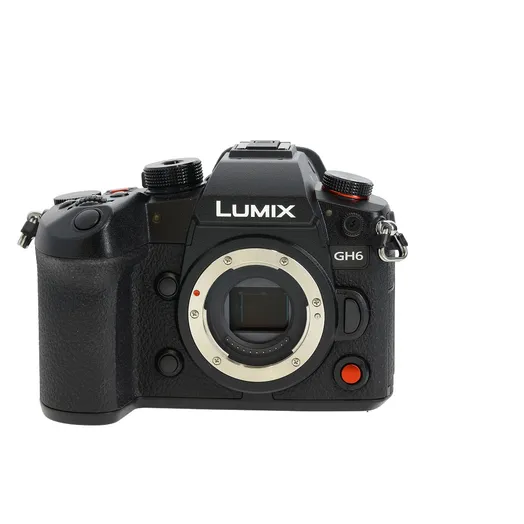
* Item pictured for illustrative purposes only, actual item not pictured. See ‘Notes’ next to grade for included items.
Panasonic Lumix GH6 Mirrorless MFT (Micro Four Thirds) Camera Body, Black {25.2MP}
-
$1,011.00
Panasonic GH6: the Micro Four Thirds camera built for serious video work.
The GH6 is built around a 25MP Four Thirds CMOS sensor with a dual output gain design, two parallel analog circuits process high and low gain data simultaneously, then composite them into a single image. Panasonic calls this Dynamic Range Boost, and in video mode it pushes claimed dynamic range to 13 stops when shooting V-Log. That sensor feeds into Venus Engine processing and a dual card system pairing CFexpress Type B with UHS-II SD, which is what makes internal Apple ProRes recording possible at resolutions up to 5.7K. Full V-Log is included from the factory, no paid unlock required.
For motion work, the GH6 covers a lot of ground. It shoots 4K at up to 120p and maintains meaningful resolution at those higher frame rates, which is not something every camera in this class can claim. The active cooling fan keeps thermal throttling out of the equation during extended recording sessions, in testing, it logged over seven hours of Cinema 4K recording on external USB power without interruption. Waveform monitors, vectorscope display, anamorphic de-squeeze, focus peaking during recording, and configurable frame markers round out a monitoring toolkit that goes well beyond what you'd typically find outside dedicated cinema bodies.
Stills shooters get 14 fps continuous shooting with the mechanical shutter at 1/8000 sec, an electronic shutter ceiling of 1/32000 sec, and a 3,686,400-dot EVF at 100% coverage. The High Res composite mode can combine eight frames in-camera to produce 100MP files, an useful option for product or architecture work on a tripod. At 823g in a weather-sealed SLR-style body with a fully articulated 3-inch touchscreen, the GH6 sits at a size-to-capability ratio that's hard to argue with for the working videographer who also needs a credible stills camera.
Who It's For
Documentary and event videographers working solo will appreciate the internal ProRes recording, unlimited runtime with active cooling, and a monitoring suite, waveform, vectorscope, focus peaking, that supports professional delivery workflows without external recorders. Slow-motion shooters get 4K at 120p in a body that holds resolution at that frame rate, making it practical for sports coverage or wildlife work where high-speed footage is the goal. Travel filmmakers who need weather sealing, USB-C charging, and a compact Micro Four Thirds lens ecosystem get all three in a body under 140mm wide. Stills photographers with mostly static subjects can tap the 100MP High Res composite mode, a meaningful upgrade over the native 25MP output when shooting product or architectural work in controlled conditions.
Key Features
- 25MP Four Thirds CMOS sensor with dual output gain and no low-pass filter
- Dynamic Range Boost pushes V-Log video to 13 stops claimed dynamic range
- 4K at up to 120p with active cooling fan preventing thermal throttling
- Internal 5.7K Apple ProRes recording on CFexpress Type B cards
- Full V-Log included from factory, no paid unlock required
- 3,686,400-dot EVF at 100% coverage with 1.52x magnification
- 14 fps burst with mechanical shutter, electronic shutter to 1/32,000 sec
- High Res composite mode generates 50.5MP or 100MP from eight frames
- Dual card system pairing CFexpress Type B with UHS-II SD
- 3-inch fully articulated touchscreen plus extensive video monitoring tools
FAQ
- What's the sensor design in the GH6, and why does it matter for video?
- It's a 25MP Four Thirds CMOS with a dual output gain design - two parallel analog circuits process high and low gain data simultaneously and composite into one frame. In video, this becomes Dynamic Range Boost, pushing claimed dynamic range to 13 stops with V-Log. It's similar to what Arri uses in cinema cameras, not the switchable dual-gain sensors you see elsewhere.
- Can the GH6 really shoot 4K at 120p without overheating?
- Yes. The active cooling fan maintains thermal stability across all 4K frame rates up to 120p on battery power. In testing, it logged over seven hours of Cinema 4K recording on USB power without throttling. The fan has three manual speeds plus two auto modes, and you can adjust the thermal threshold in the menu.
- What's included for video grading - is V-Log a paid add-on?
- Full V-Log ships from the factory with no unlock required. You also get HLG for HDR workflows, plus monitoring tools: waveform and vectorscope displays, focus peaking during recording, anamorphic de-squeeze, and frame markers for every aspect ratio. Internal Apple ProRes recording at 5.7K is available for CFexpress cards.
- Does the GH6 use phase-detection autofocus?
- No, it uses Panasonic's Depth-from-Defocus (DFD) contrast-detection system with 315 AF points and deep-learning subject detection for faces, eyes, bodies, and animals. DFD works well for stills and slower video, but shows visible focus pulsing in high frame-rate footage - it's not comparable to phase-detect AF systems for fast-moving subjects. DFD also only works with Panasonic lenses.
- How much resolution can High Res mode deliver?
- The camera composites eight frames in-camera, with two output options: LL (50.5MP) or XL (100MP). Both work handheld but yield best results on a tripod with static subjects. At 100MP, it resolves noticeably finer detail than the single 25MP frame, matching full-frame competitors that capture this in one shot.
- What cards does the dual card slot use, and why both types?
- CFexpress Type B pairs with UHS-II SD. CFexpress handles the high bitrate work - internal 5.7K Apple ProRes requires it. SD cards work for standard recording and backup. The dual system gives you flexibility without forcing expensive CFexpress for every job.
- How does the articulated screen work with the cooling fan?
- The 3-inch LCD both tilts and swings out fully, positioned far enough back that it never collides with cables. The fan protrudes slightly from the back but doesn't interfere with EVF use or screen operation. It's a clever mechanical compromise for a video-focused body.
| Specification | Value |
|---|---|
| Sensor | Four Thirds (17.3 x 13 mm) |
| Resolution | 25.0 MP |
| Mount | Micro Four Thirds |
| ISO Range | 100-25,600 |
| Burst Rate | 14.0 |
| Stabilization | Sensor-shift |
| Viewfinder | Electronic |
| Connectivity | Built-in (2.4GHz 802.11b/g/n, 5GHz 802.11a/n/ac) |
| Battery | Li-ion Battery Pack (7.2V, 2200mAh, 16Wh) |
| ISO Boost Min | 50 |
| ISO Boost Max | 25,600 |
| Image Ratio | 1:1, 4:3, 3:2, 16:9 |
| Other Resolutions | 3:2 (5,776 x 3,848), 16:9 (5,776 x 3,248), 1:1 (4,336 x 4,336) |
| JPEG Quality Levels | Fine, Standard |
| Digital Zoom | Yes (2x-4x) |
| Manual Focus | Yes |
| Articulated LCD | Fully articulated |
| Screen Size | 3" |
| Screen Type | TFT LCD |
| Min Shutter Speed | 60 sec |
| Max Shutter Speed | 1/8,000 sec |
| Max Shutter Speed Electronic | 1/32,000 sec |
| Aperture Priority | Yes |
| Shutter Priority | Yes |
| Manual Exposure | Yes |
| Subject Scene Modes | No |
| External Flash | Yes (TTL External Flash, sold separately) |
| Flash Modes | Auto, Auto/Red-eye Reduction, Forced On, Forced On/Red-eye Reduction, Slow Sync., Slow Sync./Red-eye Reduction, Forced Off |
| Video Format | MPEG-4, H.264, H.265 |
| Microphone | Stereo |
| Speaker | Mono |
| Storage Types | CFexpress Type B, SD (UHS-II) |
| USB | USB 3.2 Gen 2 (10 GBit/sec) |
| USB Charging | Yes |
| HDMI | Yes (Type-A) |
| Microphone Port | Yes |
| Headphone Port | Yes |
| Remote Control | Yes (wired or smartphone) |
| Weather Sealed | Yes |
| Battery Life Cipa | 360 |
| Dimensions | 138 x 100 x 100 mm (5.45 x 3.95 x 3.92") |
| Weight | 823 g (1.81 lb / 29.03 oz) |
This description was generated using AI based on KEH's internal product standards, product expertise, and knowing what customers care about most. While we strive for accuracy, details may vary by individual item.
| Brand Name | Panasonic |
|---|---|
| Focus Type | Autofocus (lens motor) |
| Lens Mount | Micro Four Thirds |
| Memory Card Type | SD, SDHC, SDHC UHS-I, SDHC UHS-II, SDXC, SDXC UHS-I, SDXC UHS-II, CFxpress Type B |